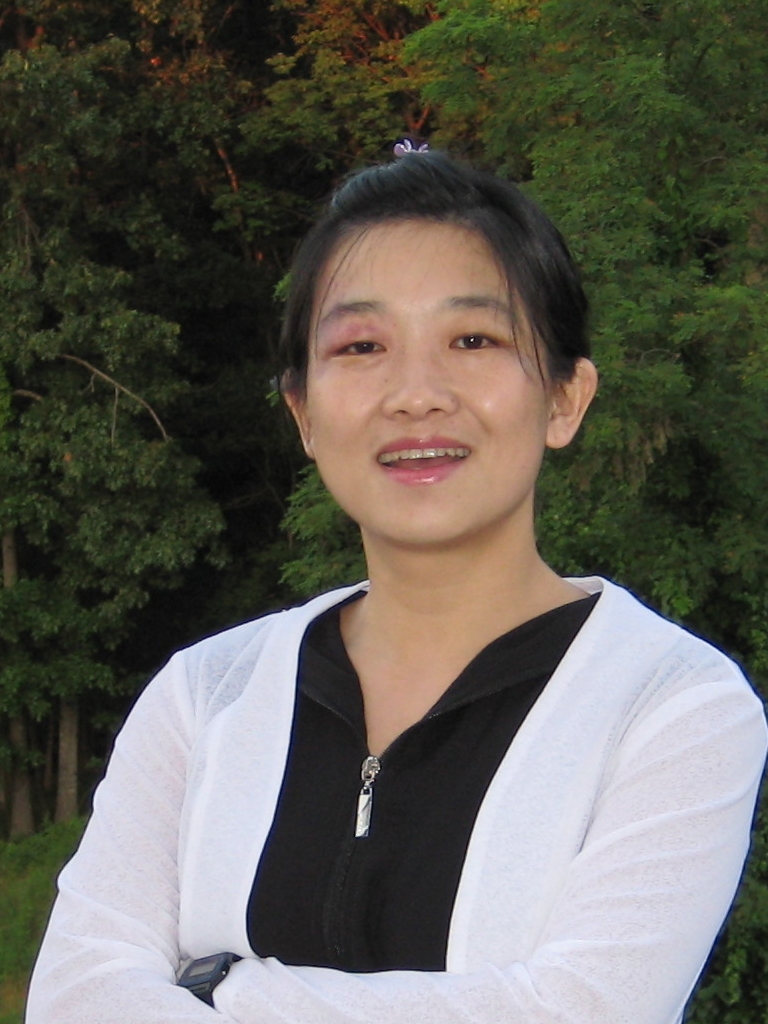
Liqing Zhang's Home Page
Research Interests
Biotechnology has revolutionized the whole field of life and medical science research, and has generated and continue to generate an overwhelmingly large amount of data at an alarmingly fast rate. Making sense of the "Big Data" poses grave challenge yet exciting research
opportunities.
Our research is about developing computational and statistical tools that can process and analyze various kinds of complex bio-data efficiently and mine the data (e.g., human genomic data, cancer data, and metagenomics data) to
help address important biological and biomedical questions,
thus facilitating the process from data to knowledge discovery.
Our interest falls into the broad category of computational omics, for various omics data,
such as
cancer genomics, metagenomics, evolutionary and comparative genomics, and
population genomics.
Some current projects include:
(1). develop computational pipelines and databases
for analyzing and mining metagenomics data, to understand the impact of microbes on humans and our environment.
(2). develop short read mapping tool for whole genome bisulfite sequencing data and statistical tool for variant calling and methylation calling in bisulfite short reads.
(3). predict the effect of genetic variations such as SNPs and indels using hidden Markov models.
(4). develop tools for studying indels. In particular, we have been developing an indel annotation
system, the adoption of which can eliminate the redundancy problem,
a serious one in indel data storage.
Teaching
Education
- B.S. Biochemistry, Lanzhou University China
- Ph.D. Molecular Evolution, University California, Irvine, with Dr. Brandon S. Gaut
- Postdoc, University of Chicago, with Dr. Wen-Hsiung Li
-
Liu M, Watson LT, Zhang L. HMMvar-func: a new method for predicting the functional outcome of genetic variants.
BMC Bioinformatics. 2015 Oct 30;16:351. doi: 10.1186/s12859-015-0781-z. PubMed PMID:
26518340;
-
Hasan MS, Wu X, Zhang L. Performance evaluation of indel calling tools using real short-read data.
Hum Genomics. 2015 Aug 19;9:20. doi: 10.1186/s40246-015-0042-2. PubMed PMID:
26286629;
-
Chen W, Zhang L. The pattern of DNA cleavage intensity around indels.
Sci Rep. 2015 Feb 9;5:8333. doi: 10.1038/srep08333. PubMed PMID:
25660536;
-
Chen W, Zhang X, Brooker J, Lin H, Zhang L, Chou KC. PseKNC-General: a cross-platform package
for generating various modes of pseudo nucleotide compositions. Bioinformatics.
2015 Jan 1;31(1):119-20. doi: 10.1093/bioinformatics/btu602. Epub 2014 Sep 16. PubMed PMID:
25231908.
-
Li Z, Wu X, He B, Zhang L. Vindel: a simple pipeline for checking indel redundancy. BMC Bioinformatics. 2014 Nov 19;15:359. doi: 10.1186/s12859-014-0359-1. PubMed PMID:
25407965.
-
Liu M, Watson LT, Zhang L. Quantitative prediction of the effect of genetic variation using hidden Markov models. BMC Bioinformatics. 2014 Jan 9;15:5. doi: 10.1186/1471-2105-15-5. PubMed PMID:
24405700.
-
Tran H, Porter J, Sun MA, Xie H, Zhang L. Objective and comprehensive evaluation of bisulfite short read mapping tools. Adv Bioinformatics. 2014;2014:472045. doi: 10.1155/2014/472045. Epub 2014 Apr 15. PubMed PMID:
24839440.
-
Lewis SN, Nsoesie E, Weeks C, Qiao D, Zhang L. Prediction of disease and phenotype associations from genome-wide association studies. PLoS One. 2011;6(11):e27175. doi: 10.1371/journal.pone.0027175. Epub 2011 Nov 4. PubMed PMID:
22076134.
-
Shi G, Zhang L, Jiang T. MSOAR 2.0: Incorporating tandem duplications into ortholog assignment based on genome rearrangement. BMC Bioinformatics. 2010 Jan 6;11:10. doi: 10.1186/1471-2105-11-10. PubMed PMID:
20053291.
-
Zhang L, Watson LT. The expected fitness cost Of a mutation fixation under the one-dimensional Fisher model. International Journal of Pure and Applied Mathematics : IJPAM. 2010; 62(2):21 pages.
-
Lawson MJ, Zhang L. Sexy gene conversions: locating gene conversions on the X-chromosome. Nucleic Acids Res. 2009 Aug;37(14):4570-9. doi: 10.1093/nar/gkp421. Epub 2009 May 31. PubMed PMID:
19487239.
-
Zhang L, Watson LT. Analysis of the fitness effect of compensatory mutations. HFSP J. 2009;3(1):47-54. doi: 10.2976/1.2990075. Epub 2008 Dec 3. PubMed PMID:
19649156.
-
Yang K, Zhang L. Performance comparison of gene family clustering methods with expert curated gene family data set in Arabidopsis thaliana. Planta. 2008 Aug;228(3):439-47. doi: 10.1007/s00425-008-0748-7. Epub 2008 May 21. PubMed PMID:
18493791.
-
Zhang L, Watson LT. Note on the computation of critical effective population sizes. J Comput Biol. 2007 Sep;14(7):950-60. PubMed PMID:
17803372.
-
Pan D, Zhang L. Quantifying the major mechanisms of recent gene duplications in the human and mouse genomes: a novel strategy to estimate gene duplication rates. Genome Biol. 2007;8(8):R158. PubMed PMID:
17683522.
-
Zhang L, Li WH. Mammalian housekeeping genes evolve more slowly than tissue-specific genes. Mol Biol Evol. 2004 Feb;21(2):236-9. Epub 2003 Oct 31. PubMed PMID:
14595094.
-
Zhang L, Gaut BS. Does recombination shape the distribution and evolution of tandemly arrayed genes (TAGs) in the Arabidopsis thaliana genome? Genome Res. 2003 Dec;13(12):2533-40. PubMed PMID:
14656961.
-
Zhang, L.Q., B.S. Gaut and T. Vision. The evolution of duplicated genes. Science
293, 2001, 1551-1552.
Professional Services
- Program Committee Service:
program committee for the 7th Annual RECOMB Satellite Workshop on Comparative Genomics,
Budapest, Hungary, 2009; Session chair for the Advanced Intelligent Computing Technology
and Applications (ICIC2008) conference, September, 2008;
Program committee for ISMB/ECCB (International Society for Computational Biology \&
8th European Conference on Computational Biology), Stockholm, Sweden, 2009;
Program committee of the fifth Asian Pacific Bioinformatics Conference 2007 (APBC 2007);
Program committee for ISMB 2008 (International Society for Computational Biology), Toronto.
- Associate Editor:
Scientific Reports;
BMC Bioinformatics
Students and Postdocs
Current
Alumni
-
Mingming Liu, PhD in Computer Science, 2015 (Now working as Software Engineer at Bloomberg)
-
Dr. Wei Chen, Visiting Scholar, 2015 (Associate Professor, Hebei United University, China)
-
Jordan Brooker, Summer Research Intern, 2015 (Now working as Research Technician at MPI Research Inc.)
-
Xitong (David) Zhang, Summer Research Intern, 2015 (Now Student of Comuter Science at University of Virginia)
-
Mark Lawson, PhD in Computer Science, 2009 (Now working as Bioinformaticist at HemoShear LLC.)
-
Deng Pan, postdoc, now at the University of Chicago.
-
Wenhui Huang, Master in Computer Science.
-
David Beck, Master in Computer Science.
-
Valia Shoja, Master in Computer Science, now at IBM.
-
Chaitanya Sanna, Master in Computer Science, now at Department of Transportation.
-
Shilpa Nadimpalli, summer DREU student, now at Stanford University.
-
Ioana Oriana Bercea, summer DREU student.
Open Position
I am looking for students who either have
strong mathematical background or excellent programming skills
and
are interested in doing interdisciplinary research
to
help address important biological or biomedical questions.