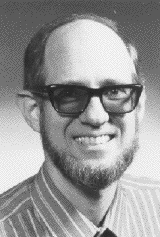
 Layne T. Watson
Professor of Computer Science, Mathematics, and Aerospace
and Ocean Engineering; Faculty of Health Sciences
(540) 231-7540
Education:
- Ph.D., 1974, Mathematics, University of Michigan, Ann Arbor.
- B.A., 1969, Psychology, University of Evansville.
Current Research Interests:
Selected Research Grants and Contracts:
- NASA. "Variable-complexity
multidisciplinary
optimization on parallel computers" (with B.
Grossman, R. T. Haftka, and W. H. Mason). 1993–96, $599,521.
- Air Force Office of Scientific Research. "Innovative local-global
methods for wing structural design" (with Z. Gurdal and R. T. Haftka).
1999–2001, $509,219.
- NSF. "A collaborative problem solving environment for modeling of
broadband wireless communication systems"
(with T. S. Rappaport, D. G. Kafura, N.
Ramakrishnan, C. A. Shaffer, and W. Tranter). 1999–2003, $1,000,000.
- NSF. "A microarray experiment management system" (with N.
Ramakrishnan, R. Alscher, L. S. Heath, and J. W. Weller). 2001–04,
$600,000.
- DARPA. "The eukaryotic cell cycle as a test case for modeling cellular
regulation in a
collaborative problem solving environment" (with J. J.
Tyson, J. C. Sible, K. C. Chen, C. A. Shaffer, and N. Ramakrishnan).
2001–06, $2,442,400.
- Air Force Research Laboratory. "AFRL-VT collaborative
center on multidisciplinary analysis and design of future aerospace vehicles
(MADFAV)"
(with R. K. Kapania, J. A. Schetz, R. A. Canfield, M. R. Hajj,
W. H. Mason, M. J. Patil, C. A. Woolsey, R. C. Batra, D. K. Tafti).
2009–2016, $5,838,758.
- NSF. "NRT-DESE:
UrbComp: Data science for modeling,
understanding, and advancing urban populations" (with N. Ramakrishnan,
M. Embree, L. House, and A. Marathe). 2015–2020, $2,999,328.
Professional Activities:
- Senior Editor: Applied Mathematics and Computation.
- Associate Editor: SIAM Journal on Optimization, ORSA Journal on
Computing, Computational Optimization and Applications, Evolutionary
Optimization, Engineering Computations, International Journal of High
Performance Computing Applications.
- Referee: Communications of the ACM; ACM Transactions on
Mathematical Software; IEEE Computer; IEEE Transactions on Systems, Man
and Cybernetics; Journal of Operations Research; Mathematical
Programming; SIAM Review; SIAM Journal on Optimization; Numerical
Methods in Fluids; Journal of Applied Mechanics; Computer Vision,
Graphics, and Image Processing; and Parallel Computing, among others.
- Member: SIAM, SIAM Activity Groups on Computational Science and
Engineering, Linear Algebra, Optimization,
and Supercomputing, IEEE, IEEE Computer Society, ACM, SIGNUM, ISSMO,
ISCE, ISIBM, SCS.
Awards and Honors:
- Member, Phi Kappa Phi, Blue Key, Psi Chi, Kappa Mu Epsilon, Phi
Beta Chi, Sigma Chi, and Upsilon Pi Epsilon.
- Special Year Lecturer, 1981, University of Maryland.
- Fellow of the IEEE.
- Best Paper Award, Sixth AIAA/NASA/ISSMO Symposium on
Multidisciplinary Analysis and Optimization.
- Alumni Award for Excellence in Research.
- DARPA BioSPICE Special Recognition Award.
- First Place George Marra Award for Excellence in Writing,
Society for Wood Science and Technology.
- Fellow of The National Institute of Aerospace.
- Dean's Award for Excellence in Research.
- Fellow of the International Society of Intelligent
Biological Medicine.
- Best Paper Award, 19th High Performance Computing Symposium,
2011 Spring Simulation Multiconference.
- 2012 Outstanding Reviewer Award, Emerald Publishing Co., for the
journal Engineering Computations.
- 2013 Outstanding Reviewer Award, Emerald Publishing Co., for the
journal Engineering Computations.
- Life Fellow of the IEEE.
Other Professional Experience:
- 2008 Visiting Melchor Chair Professor, Department of Aerospace
and Mechanical Engineering, University of Notre Dame, Notre Dame, IN.
- 1995-96 Departments of Aerospace and Mechanical Engineering,
Computer Science and Engineering, and Mathematics, University of Notre
Dame, Notre Dame, IN.
- 1985-86 Departments of Electrical Engineering and Computer Science,
Industrial and Operations Engineering, and Mathematics, University of
Michigan, Ann Arbor.
- 1984 Applied Mathematics Division, Sandia National Laboratories,
Albuquerque, NM.
- 1975-78 Department of Mathematics, Michigan State University, East
Lansing.
- 1969-75 Department of Mathematics, University of
Michigan, Ann Arbor.
- 1969-78 Computer Systems Consultant, Wright,
Griffin, Davis, & Co., CPA's, Ypsilanti, MI.
Selected Publications (from over 600):
- B. B. Lowekamp, L. T. Watson, and M. S. Cramer, "The cellular
automata paradigm for the parallel solution of heat transfer problems",
Parallel Algorithms Appl., 9 (1996) 119–130.
- S. Burgee, A. A. Giunta, V. Balabanov, B. Grossman, W. H. Mason, R.
Narducci, R. T. Haftka, and L. T. Watson, "A coarse grained parallel
variable-complexity multidiscplinary optimization paradigm",
Internat. J. Supercomputer Appl. High Performance Comput., 10
(1996) 296–299.
- L. T. Watson, M. Sosonkina, R. C. Melville, A. P. Morgan, and H. F.
Walker, "Algorithm 777: HOMPACK90: A suite of FORTRAN 90 codes for
globally convergent homotopy algorithms", ACM Trans. Math.
Software, 23 (1997) 514–549.
- A. P. Morgan, L. T. Watson, and R. A. Young, "A Gaussian derivative
based version of JPEG for image compression and decompression", IEEE
Trans. Image Processing, 7 (1998) 1311–1320.
- J. F. Rodriguez, J. E. Renaud, and L. T. Watson, "Convergence of
trust region augmented Lagrangian methods using variable fidelity
approximation data", Structural Optim., 15 (1998) 141–156.
- D. T. Krasteva, L. T. Watson, C. Baker, B. Grossman, W. H. Mason, and R.
T. Haftka, "Distributed control parallelism in multidisciplinary
aircraft design", Concurrency: Pract. Exper., 11 (1999) 435–459.
- S. M. Wise, A. J. Sommese, and L. T. Watson, "Algorithm 801:
POLSYS_PLP: A partitioned linear product homotopy code for solving
polynomial systems of equations", ACM Trans. Math. Software,
26 (2000) 176–200.
- L. T. Watson, "Theory of globally convergent probability-one homotopies
for nonlinear programming", SIAM J. Optim., 11 (2000) 761–780.
- A. Goel, C. A. Baker, C. A. Shaffer, B. Grossman, W. H. Mason, L. T.
Watson, and R. T. Haftka, "VizCraft: a problem solving environment for
configuration design of a high speed civil transport",
Comput. Sci. Engrg., 3 (2001) 56–66.
- J. He, L. T. Watson, N. Ramakrishnan, C. A. Shaffer, A. Verstak, J.
Jiang, K. Bae, and W. H. Tranter, "Dynamic data structures for a direct
search algorithm", Comput. Optim. Appl., 23 (2002) 5–25.
- N. Allen, L. Calzone, K. C. Chen, A. Ciliberto, N. Ramakrishnan, C. A.
Shaffer, J. C. Sible, J. J. Tyson, M. Vass, L. T. Watson, and J. Zwolak,
"Modeling regulatory networks at Virginia Tech", OMICS,
7 (2003) 285–299.
- H.-J. Su, J. M. McCarthy, and L. T. Watson, "Generalized linear
product homotopy algorithms and the computation of reachable
surfaces", ASME J. Comput. Information Sci. Engrg., 4 (2004)
226–234.
- R. T. Haftka and L. T. Watson, "Multidisciplinary design
optimization
with quasiseparable subsystems", Optim. Engrg., 6 (2005) 9–20.
- H.-J. Su, J. M. McCarthy, M. Sosonkina, and L. T. Watson,
"Algorithm
857: POLSYS_GLP—a parallel general linear product homotopy code
for solving polynomial systems of equations", ACM Trans. Math.
Software, 32 (2006) 561–579.
- J. W. Zwolak, P. T. Boggs, and L. T. Watson, "Algorithm 869: ODRPACK95:
a weighted orthogonal distance regression code with bound constraints",
ACM Trans. Math. Software, 33, Article 27 (2007) 1–12.
- M. A. Gonçalves, E. A. Fox, and L. T. Watson, "Towards a
digital library theory: a formal digital library ontology",
Internat. J. Digital Libraries, 8 (2008) 91–114.
- J. He, L. T. Watson, and M. Sosonkina, "Algorithm 897:
VTDIRECT95:
serial and parallel codes for the global optimization algorithm
DIRECT", ACM Trans. Math. Software, 36, Article 17 (2009)
1–24.
- W. I. Thacker, J. Zhang, L. T. Watson, J. B. Birch, M. A. Iyer, and
M. W. Berry, "Algorithm 905: SHEPPACK: modified Shepard algorithm for
interpolation of scattered multivariate data", ACM Trans. Math.
Software, 37, Article 34 (2010) 1–20.
- N. Ramakrishnan, S. Tadepalli, L. T. Watson, R. F. Helm, M. Antoniotti,
and B. Mishra, "Reverse engineering dynamic temporal models of biological
processes and their relationships", Proc. National Academy of
Sciences, 107 (2010) 12511–12516.
- R. D. Phillips, L. T. Watson, R. H. Wynne, and N. Ramakrishnan,
"Continuous iterative guided spectral class rejection classification
algorithm", IEEE Trans. Geoscience Remote Sensing, 50 (2012)
2303–2317.
- L. T. Watson, S. C. Billups, J. E. Mitchell, and D. R. Easterling,
"A globally convergent probability-one homotopy for linear programs with
linear complementarity constraints", SIAM J. Optim., 23 (2013)
1167–1188.
- D. R. Easterling, L. T. Watson, M. L. Madigan, B. S. Castle, and M. W.
Trosset, "Parallel deterministic and stochastic global minimization of
functions with very many minima", Comput. Optim. Appl., 57 (2014)
469–492.
- C. Raghunath, L. T. Watson, M. Jrad, R. K. Kapania, and R. M. Kolonay,
"Service ORiented Computing EnviRonment (SORCER) for deterministic
global and stochastic aircraft design optimization: part 1",
Advances Aircraft Spacecraft Sci., 4 (2017) 297–316.
My work is at the interface of computer science,
mathematics, and engineering. The overall goal is to provide
sophisticated mathematical software, justified by rigorous mathematical
analysis, to attack significant practical engineering and scientific
problems. An example is the
HOMPACK project that was designed to make
mathematically obscure homotopy methods available to the typical
engineer, and to provide production quality software to the user
community. HOMPACK is now in use at hundreds of sites from Australia to
Yugoslavia, and it has been successfully applied to problems in fluid
mechanics, solid mechanics, composite materials, chemical engineering,
economics, biology, robotics, computer vision, optimal control, circuit
design, machine learning, and nonlinear optimization.
Over the years, I have done
mathematical analyses in the areas of approximation theory, homotopy
theory, optimization, nonlinear equations, and computer vision.
Recently, my focus has been on the application of parallel computation to
large scale, interdisciplinary
engineering problems, and to bioinformatics.
 www.wseas.org