CS 5614 Homework #2
Solution Sketches
- Having a multiway relationship is better when
(a) we would like the diagram to bring out more naturally the fact that
the relationship extends to more than two entity sets (it
will be more difficult to enforce this via participation
constraints in the other design; the reason being schema is
abstracted as data in the new connecting entity set) or (b)
if we would not like weak sets in our design (since they
increase the number of attributes); notice that connecting
entity sets obtained from multiway relationships are likely to
be weak. We might choose to add a defining attribute which will
further complicate the design. A third elegant reason has been
brought to my attention by Batul Mirza. (c) The idea is as follows:
Since the "push-out" construction models the original multiway
concept by the actual data in the new connecting entity set, there is
an implicit assumption that the data will be consistent with any
"-one" constraints that were present in the original multiway design.
Notice that this is an issue because irrespective of the -one constraints
in the original multiway, the final E/R diagram obtained by pushing-out is
the same! :-) Thus, it is conceivable that the pushed-out design could
potentially invalidate the -one constraints by allowing inconsistent data!
The only case when you could never invalidate it by placing spurious data
is if there were no arrows in the multiway.
Thus, the third reason is that the original design is better if
there are any "-one" constraints in the multiway design.
Replacing it via a connecting entity set is better when (a) the
relationship has an "existence"/"identity" in the real world (in addition
to serving as a relationship). This occurs in relationships such as
"contracts" etc., (b) when the connecting entity set could potentially
relate (to) many combinations of entities from the other sets (contracts
again), or (c) when implementation considerations insist
on either binary relationships or many-one constraints (we saw this
earlier in the context of the network model).
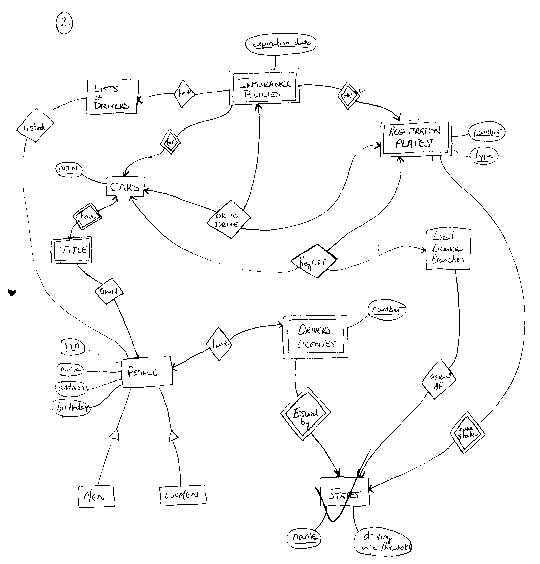
- <your answer here> Here's a good solution by Robert Capra.
Notice that some of the constraints not modeled by the diagram (and which
go in the notes) are (i) that people cannot be both men and women, (ii)
a car can have only one registration plate and the "registered" plate
must be the same as the plate considered in the "ok to drive" relationship.
(iii) People can only have a driver's license if their birthday is before
the driving age threshold for the state issuing the license. The assumptions
made in the diagram are: (i) Driving licenses are a weak set because
the numbers are not unique across states, (ii) for any given car and owner,
there is a title declaring that ownership, (iii) local license branches
register vehicles for a particular state. If the state were to go away,
the registration process would probably change.
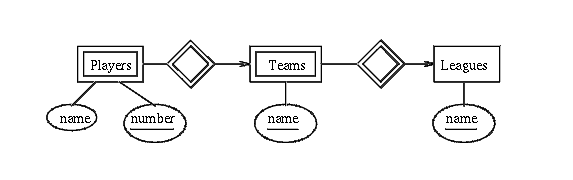
- The question itself indicates that there is a hierarchy of
weak sets. Here's a solution (courtesy Ullman).
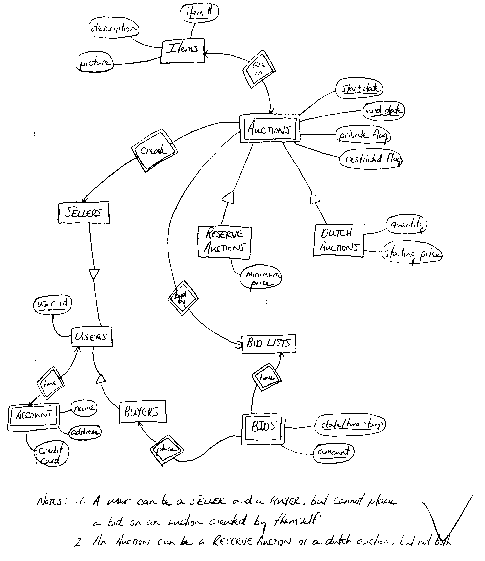
- <your answer here> Here's a solution outlining a database
model for the Ebay auctions site (courtesy Capra again).